Small business owners often get confused about the difference between a Data Privacy Policy and a Data Processing Agreement (DPA)—and with good reason! The names sound similar, and both involve handling personal data. But they serve very different purposes and are used in different situations.
Let’s break them down in plain English.
What is a Data Privacy Policy?
A Data Privacy Policy is a document you use to explain to the people whose data you’re collecting (called data subjects) what you’re collecting, why, and who you’re sharing it with.
Any time you store or use information about prospective customers, clients, suppliers, contractors, or team members—even just their name and email—you’re dealing with personal data. Your Data Privacy Policy should cover this.
It’s not just a “website thing.” Even if you don’t have a website, you’re likely handling personal data in your:
- Email inbox
- Accounting software
- Client management tools
- Cloud storage
- Contracts and communications
- Address book and phone book
Having a Data Privacy Policy is your way of creating transparency, which is a legal obligation. As the owner of your business, you are a data controller. That means you decide what to collect and what to do with it—and you’re responsible for informing people accordingly.
✅ Bottom line: If you’re collecting or storing anyone’s personal data for your own business, you need a Data Privacy Policy.
What is a Data Processing Agreement (DPA)?
A Data Processing Agreement (DPA) is something your client gives to you—not the other way around. It’s used when you are processing personal data on behalf of someone else.
In this case, your client is the data controller, and you’re acting as their data processor.
A DPA tells you:
- What personal data you can access
- How you’re allowed to use it
- Whether you can download it or only access it through their system
- Who else you’re allowed to share it with (e.g. associates, subcontractors)
- How to add new team members who might have access
A DPA is a private agreement between two parties—it doesn’t get published on a website. And while many clients skip this step (often out of ignorance), This still needs to be in place when personal data is being shared. This protects everyone involved by giving clear instructions about who is doing what and why.
✅ Bottom line: If you’re handling personal data for a client (for example, their mailing list, customer records, HR data, etc.), they should be issuing you with a DPA.
How They Work Together
A Data Privacy Policy is your declaration of how you collect and use data.
A Data Processing Agreement is your client’s instruction to you about how to handle their data.
These two should never contradict each other. For example, if your client’s privacy policy says “we never share data,” but they’re sending you spreadsheets full of it—that’s a red flag!
When you’re running your own business, you might be both a data controller and a data processor, depending on the relationship.
Real-Life Scenario
When you were employed, someone else took care of all this. Now that you’re the boss, it’s your responsibility. And it can feel like a lot!
Most people have heard about needing a privacy policy… but the DPA side of things often comes as a bit of a shock.
Let’s simplify with a quick decision-making guide:
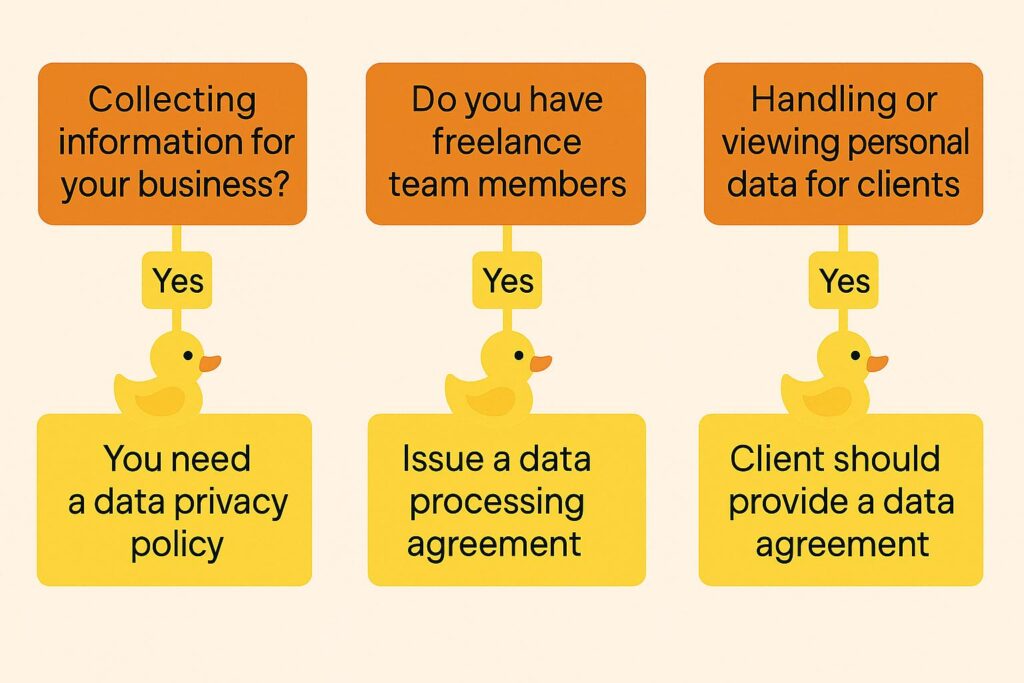
Don’t worry—we’re here to help you get those ducks in a row
If this feels like a lot to take in, you’re not alone. The good news? You don’t have to figure it all out on your own.
Need a Data Privacy Policy?
If you don’t yet have a privacy policy for your business, you can get one with a free AI policy and a mini-course to help you sort out those pesky cookies too!
If your client doesn’t have one of their own, why not recommend they get one?
Already have a KoffeeKlatch Hiring Agreement?
Brilliant! That means you already have what you need to create a Data Processing Agreement for your team members—with video guidance and group support to help you fill it in with confidence.
Using KoffeeKlatch Terms of Business with your clients?
Perfect. You’ve already got what you need to create a DPA if your client hasn’t issued one to you. No awkward conversations—just professional, compliant paperwork that’s already built in. We know they often can’t or don’t so this is designed to help you get those ducks in a row.
Want to know more?
If you’re still not sure which ducks go where—or what to do with them—we’ve got you covered.
Pop into your customer support group on Facebook if you are already a customer, or if you’re thinking of purchasing reach out to us by emailing support@koffeeklatch.co.uk and we’ll help you figure out your next step.
Or dive straight into our GDPR-friendly resources and get the tools, templates, and support you need to run your business with confidence.
Because once your ducks are in a row, everything else runs a lot more smoothly.